When Critique Meets Power: A Field Guide to Being Pressured Into Silence


Read this first
This piece is about a tactic, not a person. It uses one recent exchange as a worked example, but the point is portable: it is meant to help activist writers, bloggers, and organizers recognize a specific pressure pattern the next time it is aimed at one of you; and yes, as I have recently learned, sooner or later, it will be.
Before I begin, let me be direct about what this is not. It is not an invitation to pile on, harass, or flood anyone's mentions. If you finish reading and your impulse is to go after the individual named here rather than to recognize the pattern the next time it lands in your own inbox, you have missed the entire argument, and you are not helping. Scrutinize public work. Leave people's mentions and DMs alone.
With that established, let's get started!
The pattern
If you publish careful, sourced criticism of someone with a platform and resources, the push back you get is often not about your analysis. It is about your process - that you should have asked first, that you were discourteous, that a decent person would have reached out. When the critique is substantive and hard to answer on the merits, the response frequently migrates away from the merits altogether.
The recognizable version runs in a rough sequence:
- A reasonable opening that affirms your right to disagree.
- A re-categorization that quietly relocates a factual dispute into the safe territory of "we just interpret things differently."
- A procedural complaint such as you didn't reach out, you skipped a courtesy, or other perceived unfairness.
- An offer of "context" that is promised but never actually produced, or cannot be verified.
- A demand to remove, correct, fabricate, or re-frame.
- A vague warning about consequences.
None of these steps engages the substance. That is the tell. And the reason to learn the sequence is simple: a tactic you can name has far less power over you. You cannot be quietly maneuvered by a script you can see on the page.
The rest of this article walks through a single real example of that script, because seeing it once in the wild makes it easier to recognize the next time.
The example
In June 2026 I published an analysis of a Substack article by Dr. Laura Targownik, "What Oregon Can Teach Canada About Pediatric Gender Medicine."[3] My piece traced her citations back to their sources and argued that the article's framing paralleled positions associated with SEGM, a comparison I laid out publicly, row by row, with a source for each.[1] Reasonable people can weigh that comparison for themselves; it stands or falls on the public record, which is exactly where I left it.
What followed ran the script cleanly enough to teach from.
Two registers, on the public record
On June 22, replying publicly, the first response to the comparison was, quoted exactly: "Fuck off, already. Seriously. You're a bad faith critic" That post was deleted shortly after and replaced with a more measured one stating opposition to SEGM's mission and warning that continued comparison was "approaching defamation territory. So just be warned."

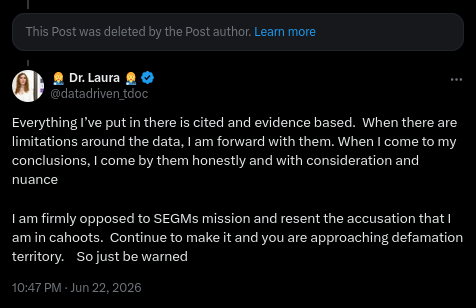
I am not going to tell you what anyone was thinking. I will only note the observable fact: a blunt dismissal was published, then withdrawn, then replaced with professional language and a legal warning. Both versions exist because both were captured. You rarely get to see the same moment expressed in two registers minutes apart. You can draw your own conclusions.
The conversation continued, ultimately leading to my being blocked.

For an independent writer, the ruin is not losing the case; it is being made to fight one at all. The fees and the months it takes to be proven right can cost more than simply going quiet.
That is what turns a legal hint into a silencing tactic. The merits never get tested, because the process is the punishment, and it lands only on the side that can be bankrupted by it. Knowing this is how you refuse to be moved by it.
The private message
On July 6, I received an unsolicited direct message, an act which required Targownik to unblock me in order to send. I am quoting it sparingly and only where specific lines are load-bearing, because the point is the structure, not anyone's embarrassment, and certainly not to create or participate in a pile-on.
It opened reasonably: a statement of fact acknowledging she read my article and that "I'm not going to be responding publicly", and an acknowledgment that "everything I do or say is legitimate grounds for criticism..." and "...I respect you're [sic] right to do it." Note the qualifier threaded through, that criticism be "legitimate and serious criticism and questioning," which does quiet work: it grants the right to criticize while implying the criticism at hand does not qualify.
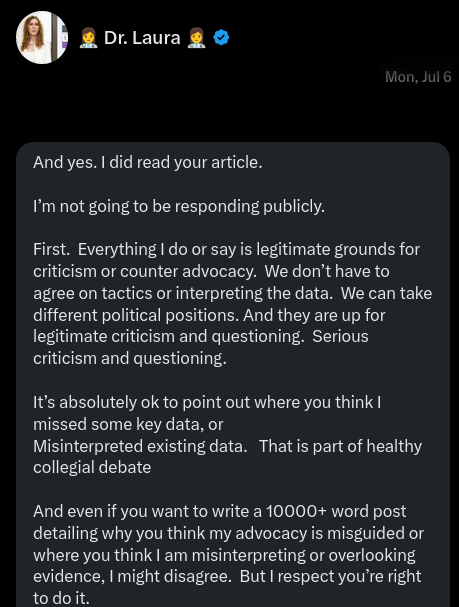
It also re-categorizes the article from substantive critique to, essentially, a difference of opinion, via the use of permissive language. However, the reasonable register does not hold. Within the same message it moves to a procedural complaint and then to a personal verdict:
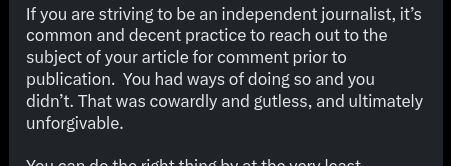
"If you are striving to be an independent journalist, it's common and decent practice to reach out to the subject of your article for comment prior to publication. You had ways of doing so and you didn't."
Then comes the concrete demand for the specific thing she wants:
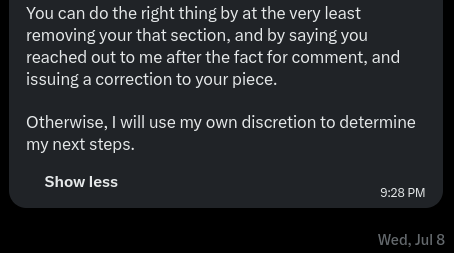
"You can do the right thing by at the very least removing your[sic] that section, and by saying you reached out to me after the fact for comment, and issuing a correction to your piece. Otherwise, I will use my own discretion to determine my next steps."
So the message is not, on inspection, calmer than the public reply. It opens calm and escalates from "I respect your right to do it" to "cowardly and gutless, and ultimately unforgivable" to a three-part demand: remove the section, state that I reached out to her after the fact, and issue a correction, closed by an unspecified warning. That is the whole script in a single message: reasonable opening, re-categorization, procedural complaint, demand, vague warning. The two substantive objections in it deserve a real answer, not a dismissal.
Silence was not an acceptable answer either. I did not respond. I sought professional and knowledgeable counsel. Two days later, after any heat of the moment had long passed, a new unprompted message arrived that I won't quote directly here; in summary, it questioned my silence and characterized it as cowardice.
This matters because it closes the last exit. Engagement had already been cast as "defamation territory"; silence was now cowardice. When every available response, including no response at all, is cast as misconduct, then it is reasonable to conclude that the complaint was never about the conduct. It was about the critique existing at all.
It is also worth naming what a message like this does, regardless of what prompts it: it applies pressure to make silence feel untenable, until you break it and say something. It only works if you take it. The reply written to prove you are not a coward is the reply written in irritation. It is unmeasured, defensive, the kind you regret. Not answering is not cowardice, it is smart, and the pressure to abandon it is precisely why.
On "you should have reached out"
The pre-publication contact convention is real and worth respecting. It comes from institutional journalism, and it is strongest when a reporter is surfacing private or undisclosed facts a subject has never had a chance to address. It is weakest for commentary on already-public work by a public figure, which is what my analysis article was. I am a blogger analyzing a public Substack post, public tweets, and a published public disciplinary record. Nothing here was leaked, confidential, or obtained through anything but reading what was already public.
There is also a timeline that complicates the complaint. Before publishing, I stated publicly that a longer analysis was coming and gestured at its contents.

There was some back and forth exchanges, and ultimately, the channel we had been using was then closed from the other side. That is to say, I was blocked by Targownik, and as far as I can tell, that channel reopened only to send the private message quoting the courtesy I had supposedly failed to extend.
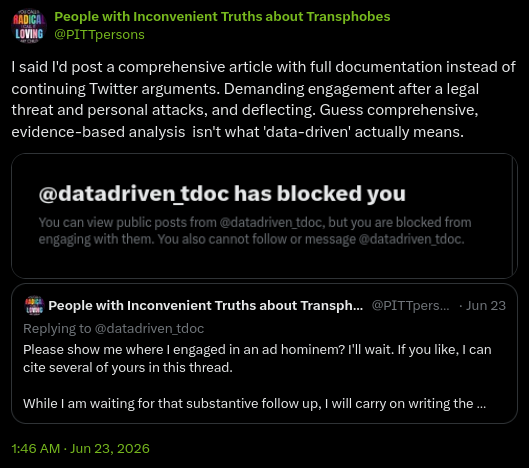
Once someone blocks you, you have two options. Route around the block to make contact anyway, or respect the boundary and work from the public record. I chose the second. My view is that the more decent choice is to honor a boundary someone has set, not to override it, and that a request for comment presupposes a channel the other party has left open. Furthermore, considering the nature and scope of my piece, and an already delivered vague legal warning, this was a courtesy to extend, not a journalistic requirement to fulfill, and that courtesy was not worth the additional legal exposure.
This reasoning does not transfer to reporting allegations of private conduct, behavior the subject had reason to expect would stay confidential, or claims that need the subject's specific knowledge to be understood or rebutted. If you are surfacing behavior someone did not disclose themselves and is not a matter of public record, or working from confidential sources or leaked material - you are obligated to reach out before you publish, regardless of whether channels are currently open, regardless if they refuse to give a comment.
The distinction: you may analyze public work without advance notice. You cannot report allegations about private conduct the same way. Honor the difference or you will eventually publish something you cannot defend. I am not a lawyer and this is not legal advice, when in doubt, seek counsel first.
On "I could have provided context"
The message indicated that, had I asked, context could have been provided, both about the missing references and the disciplinary censure. Two things need saying, because on scrutiny it is weaker than it first appears.
First, it presupposes an open channel. An offer to provide context on request only means something if requests can reach you. The channel had been closed from the other side. You cannot withhold context by closing the door and then fault the other person for not knocking.
Second, "you could have asked for the missing citations" mistakes what the critique actually said. This was never a complaint that a reference or two slipped through the cracks. Everyone who writes loses a citation now and then, and I even said so at the time in my article. I extended exactly that courtesy in the original piece, writing "let us be charitable," going looking for the strongest study she might have meant, granting it to her, and showing the argument failed even on the most generous possible reading. The charitable interpretation was already tried, in print, before any of this.
The was an additional aspect to my critique, which was more structural, not clerical. A clinician whose public identity is built on critiquing trans-health literature did not simply forget a source. She presented two conflicted reviews as representative of the available literature while omitting the more comprehensive and abundant long-term directional evidence pointing the other way. Missing one citation is an oversight, even two. But when a published article omits the broader body of work in a field you present yourself as knowledgeable in, and includes only two problematic reviews that support your conclusion, that is quite the oversight. No "I could have sent you the reference or citation" answers that, because the problem was never the absence of a single citation; it was the shape of what was included and what was left out.
On the censure: a note on what I chose not to do
I referenced Dr. Targownik's 2020 censure for one narrow purpose: as independent corroboration, by a neutral body, of the same pattern the analysis had already identified in the current work. It grounds the pattern in the public record of an independent body rather than resting on my reading alone.
I want to be precise about what I did and did not draw on, because the line matters. I quoted the Investigation Committee's own findings and published conclusions, in its own words. I paraphrased around points that would highlight particulars that would be irrelevant to the point being made because they could potentially be damaging to Targownik. So I did not reproduce the underlying particulars the record contains. I read it all, and I left the particulars there. If the goal had been to injure a reputation, that material, not the tribunal's dry conclusions, is what a hit piece would have led with. I declined to write that article. It wasn't about Targownik's capacity, capability, professionalism, or character as a person. I made this clear in the closing as well.[1]
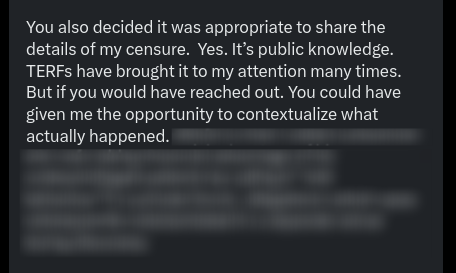
So when the private message says I "decided it was appropriate to share the details of my censure," it flattens the very distinction I was careful to keep. I did not share the details. I cited the findings of a neutral tribunal and left the details alone - which is the opposite of mud-slinging or impugning her reputation.
The message also offers to "contextualize what actually happened." But the finding is not mine to re-hash, and it is not hers to revise by private assurance. A published conclusion by a neutral body does not dissolve because sympathetic context or confidential evidence is promised off the record. If information exists that would change what the record says, the place to change it is the record itself, not a direct message to the person who cited it.
On "I could tell you off the record"
The message offered private, off-the-record context: that the matter had been substantiated in another venue, but that the terms of a legal settlement prevent it being discussed publicly, and that this could have been shared informally had I reached out.
I want to treat this respectfully, because it may well be sincere. Unfortunately, it does not change the analysis, and it is worth being precise about why.
Unverifiable context cannot displace a verifiable finding. This is not a comment on anyone's honesty. It is a rule that has to apply to everyone equally, or it protects no one. If off-the-record assurances could override a neutral tribunal's published conclusions, then any published finding about anyone could be neutralized by a claim of exculpatory evidence that, conveniently, cannot be shown. The whole point of a public finding is that it rests on a record; the whole problem with private context is that it does not. I could be told the most exonerating story imaginable, complete with an offer of proof I am not permitted to keep or check, and it would still be exactly as load-bearing as no story at all.
And this is precisely where the original analysis should make a reader cautious rather than credulous. The core finding there was that claims were presented as settled that did not survive being checked against the sources. The lesson of that is not "distrust this person"; it is "verify, then trust." An invitation to accept significant claims on the condition that they cannot be verified asks for the opposite of what the evidence recommends.
Finally, a source that cannot be independently verified by the reader is not something I, or anyone, should use to alter what the facts say, or what conclusion is drawn. To do so would not be following where the data and facts lead. Any such appeal to the contrary should be a flag for caution.
On "this is an attack on my reputation"
In the message she sent me, she accuses me of deciding to impugn her reputation with my article and the inclusion of the censure, which appears again running through this public twitter exchange, and seems to be a recurring characterization: that the critique is a "hit piece," that it goes "over the line" by attacking character and reputation, that it is "the kind of nonsense I would expect… if this was actually a TERF writing it, and not a member of the community."
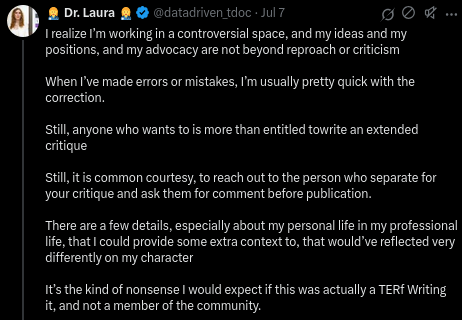
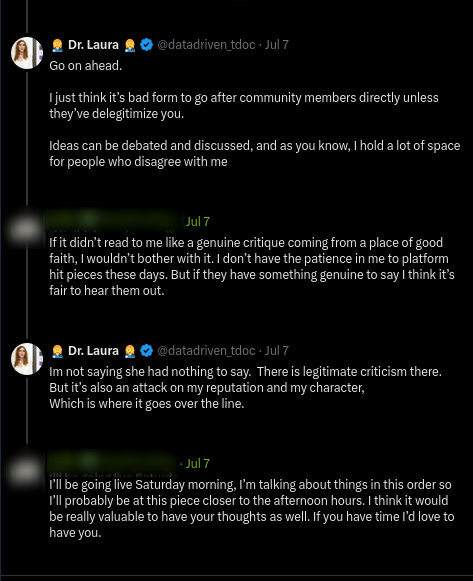
It is worth naming this move, because it is the same one identified in the original article:
selective framing. An analysis of a public article's use of evidence is reclassified as a personal attack, which shifts the question from is the analysis correct to is the critic being cruel. Once that swap is made, the evidence never has to be answered.
But the substance and the person are not the same thing. The original piece analyzed citations, framing, and the selection of sources in a public article about healthcare policy. It did not comment on anyone's private life, appearance, identity, or worth as a person or professional. Referencing a public disciplinary finding, narrowly and without particulars, is not an attack on character; it is a citation to the public record. A critique can be sharp, unwelcome, and entirely about the work. This one is.
The "TERF" framing is worth isolating because it is not really addressed to me; it is addressed to her audience, and it does a specific job. It attaches a discrediting label to me, the critic, before the critique is read, so that readers arrive already primed to dismiss it. That is well-poisoning: the effect is not to answer the analysis but to ensure it is never weighed on its merits. It also quietly rewrites the story from "a doctor's use of evidence was questioned" to "a community member was attacked by a hater." Once that frame takes hold, the substance no longer has to be met; every citation in the piece is pre-coded as an attack, and examining the evidence starts to look like taking the hater's side. That is the function of the label as it is deployed here, whatever the intent behind it may be: it changes what the audience thinks the argument is about before they have seen it.
Solidarity is not immunity
The reason any of this matters beyond one exchange is a standard worth defending. As Dr. Rachel Saunders argued recently[2], communities that hold outsiders to account for bad evidence have to hold insiders to at least the same standard. This is because the work published from inside a community carries a credibility that makes weak arguments travel further, not less far. When someone's public work bears on how healthcare is perceived or delivered to vulnerable people, membership in a shared community is a reason for careful scrutiny, not an exemption from it.
"Go easy, we're on the same side" is a powerful way to shield an argument from examination. It works by making the critic feel like the betrayer. It shouldn't. Rigorous, sourced, public critique of public work is not disloyalty; it is the thing that keeps a community's evidence honest and factual.
Such critique of public work from within the community is not aggression; it's correction. It is the mechanism by which a community insulates itself from the damage that flawed but credentialed and platformed work can do, intentional or otherwise. When someone responds to that critique with intimidation rather than engagement, they are not protecting themselves from harm. They are insulating themselves from accountability in a way that leaves the rest of the community exposed to the harm their work may cause.
The tactics have no side
There is an irony here worth naming carefully, because it is easy to get wrong.
The critique was dismissed as the kind of thing "a TERF" would write. But look at what actually occurred, and set aside for a moment who was involved. A piece of sourced, public analysis was met with: a public warning that continuing it was "approaching defamation territory — so just be warned"; a private message closing with "I will use my own discretion to determine my next steps"; a demand that a section be removed; and repeated appeals to community membership as a reason the critique should not have been made. Insults and personal attacks. Two separate warnings, both aimed not at the accuracy of the analysis but at whether it should exist.
Strip the names off that list and ask where you have seen it before. It is the standard toolkit for making inconvenient analysis go away: threaten the cost of continuing, re-frame scrutiny as an attack, and sort the critic, or the method of critique, into an out-group whose objections can be dismissed unheard. These moves are not left or right, insider or outsider. They belong to whoever, in a given moment, would prefer that a piece of evidence not be examined.
That is the actual point, and it is bigger than any one person. A community earns its authority by applying the same standard to itself that it applies to its opponents. When we condemn legal intimidation, guilt-by-identity, and appeal to community solidarity as silencing tactics, as we rightly do when they are aimed at us, we do not get to pick them up when they are convenient. The moment we do, we have conceded that our objection was never to the tactics themselves, only to who was using them against us.
And here is the lesson. When name calling and slur-slinging begin, do not give in to the temptation to return the favor, or to defend yourself against them. I refused to return the label. So should you, because the label is the tactic, and the tactic is the thing worth refusing. I will only observe that the behavior aimed at shutting down this critique is the same behavior the community claims to stand against, and that this should trouble anyone who cares that we hold ourselves to our own standards.
What to do when this is aimed at you
Distilled, for anyone who finds this pattern pointed in their direction:
- Analyze public work openly, cite your sources, and link the primary documents so readers can check you.
- Keep the receipts: screenshots, dates, blocks, deletions if possible, before they change.
- Take legal signals seriously without being governed by them. "Be warned" and "next steps" are pressure; they are not a verdict on whether your analysis is correct. Don't panic. Seek qualified advice or legal counsel. Remember that you don't need to be certain of your legal position to publish, but knowing where you stand, even informally, changes how a vague threat feels when it lands.
- Respect boundaries and document that you did. If someone closes the channel, working from the public record is defensible.
- Stay inside the limits of any finding you cite, and decline to publish irrelevant damaging details that you could have. Restraint is both the right thing and the strongest position. Restraint is evidence based, facts lead analysis; irrelevant yet damaging details make a hit piece.
- Don't return fire in kind. The cooler and more sourced you are, the harder you are to caricature, and the less fuel you hand anyone who wants to call this a personal attack.
- Don't pile on, and tell others not to. Naming a tactic is useful. Hounding a person is not. Counter with facts and evidence, not bullying and name-calling. Trust that accurate work outlasts inaccurate work, and claims that keep failing verification eventually loses their audience on its own, without anyone needing to be hounded in a pile-on.
I am publishing this to make this one pattern legible, so that the next writer who meets it recognizes it and isn't quietly talked out of work that stands on its evidence through pressure or intimidation. That is all. The analysis of the underlying article stands on its own sources; this is only about how the response to it illustrates a script worth knowing, what we can learn from it as it applies to accountability, and about holding our own to the standard we ask of everyone else.
[1] Valerie (July 5, 2026). The Inconvenient Truth About Advocacy Disguised as Analysis. Inconvenient Truths https://valah.blog/the-inconvenient-truth-about-advocacy-disguised-as-analysis-2/
[2] Saunders, R. (2026, July 4). Dear LGBTQI+ community, we need to talk about evidence. Medium. https://rejserin.medium.com/dear-lgbtqi-community-we-need-to-talk-about-evidence-65ca7caff81b
[3] Targownik, L. (2026, June 21). What Oregon can teach Canada about pediatric gender medicine. Data-Driven Transsexual. https://datadriventranssexual.substack.com/p/what-oregon-can-teach-canada-about