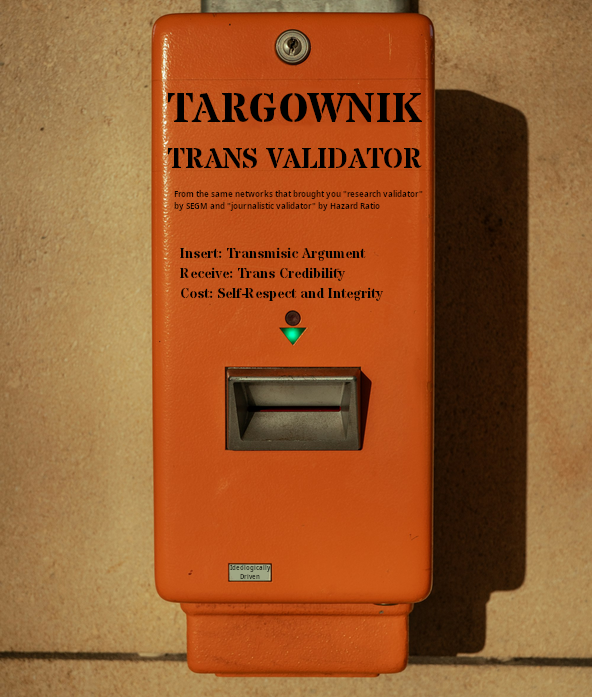
A Brief Study in Rhetorical Coercion


An analysis and response to Brianna Wu's comment on my essay "I Will Not Make That Trade"
Brianna Wu left a comment on my last essay that I want to take seriously. Not because it landed, it mostly didn't, but because buried inside the strawmen and the closing dismissal, there is one genuine question. And it deserves a genuine answer.
She wrote: "throwing out any connection to reality doesn't end gatekeeping... it just replaces it with pure assertion, which immediately falls apart the second it hits law, medicine, or real-world conflict."
She asks what works in law, medicine, and policy.
I will get to that; but first, let's look at what she actually said, because an argument is only as strong as the claims it makes.
The comment, claim by claim.
Here is what Wu wrote, in full:
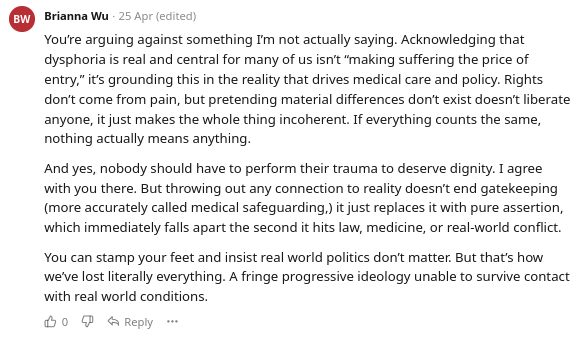
Before examining each claim, it is worth pausing to notice something about the shape of this argument as a whole. Each of the five moves Wu makes here: the strawman, the conceded premise immediately retreated from, the definitional dilution, the language capture, and the closing dismissal - this is a rhetorical tool that appears with regularity in anti-trans and conservative discourse. That does not mean Wu is consciously echoing those arguments. She may not be. But these tools travel. They get picked up. And the fact that this particular set of tools is being deployed, in this particular combination, from inside the community against a member of that community, is not incidental. It is exactly the mechanism several of my earlier essays exist to name. The logic of oppression doesn't stay outside. It finds new mouths.
With that in mind:
Claim one:
"You're arguing against something I'm not actually saying."
My essay called dysphoria "a legitimate pain." It did not deny that dysphoria is real, that it drives medical care for many people, or that it is central to many trans lives. What it argued, what Brianna did not address, is that dysphoria should not be a prerequisite. That "real for many" has been quietly converted into "required of all." Brianna opened her response by accusing me of misrepresentation, and then responded to a claim I did not make. That is a strawman, and it does the heaviest structural work in her comment.
For further reading on how "real for many" becomes "required of all" across different trans experiences, see "The Mirage of Protection." For why the gatekeeper position gets defended so tenaciously even by those it harms, see "The Price Is Us."
Claim two:
"Rights don't come from pain — but pretending material differences don't exist doesn't liberate anyone."
This is the comment's most interesting moment, because Brianna concedes my central premise — rights don't come from pain — and then immediately pivots as though she hadn't. Having agreed with me, she accuses me of pretending material differences don't exist. But nothing in my essay denies that some trans people experience profound dysphoria. It denies that the presence or absence of that dysphoria should function as a currency of legitimacy. She has collapsed the distinction between acknowledging a reality and requiring it as proof of authenticity. Those are not the same claim. The collapse is doing a great deal of work for her argument, and it isn't honest work.
For further reading on the psychological mechanism of why this concession gets made and then immediately retreated from — acknowledging it fully would cost too much — see "The Price Is Us."
Claim three:
"If everything counts the same, nothing actually means anything."
This is the definitional dilution argument. And I want to be precise about what that means, because it has a history.
- Against marriage equality: If anyone can marry anyone, marriage means nothing.
- Against trans women in women's spaces: If anyone can be a woman, "woman" means nothing.
- Against expanding disability protections: If everything is a disability, disability protections mean nothing.
- Against hate crime legislation: If everything is a hate crime, nothing is.
The structure is identical to the one she has just used. Brianna has applied it one level inward: if all trans experiences count, trans identity means nothing. But the logical skeleton is the same conservative definitional dilution argument that has been deployed against every civil rights expansion in modern history. It assumes that recognition is a scarce resource that gets devalued by distribution.
The historical record does not support this assumption. Recognizing Black Americans as full citizens did not make citizenship meaningless. Recognizing women as full citizens did not make citizenship meaningless. Marriage equality did not make marriage meaningless, despite that being the central conservative argument against it for a decade. Every expansion was predicted to dilute meaning. None of them did. The definitional dilution argument has a perfect record of being wrong.
I did not argue that all trans experiences are identical or interchangeable. I argued that the presence or absence of dysphoria should not determine who counts as trans. Brianna is arguing against a position I did not take, using a tool borrowed from people who would use it against both of us.
For the historical arc showing that every rights expansion was predicted to dilute meaning and none did, see "We Are Its Gravity." For how the tools of conservative argumentation get picked up and reused within the community, see "The Fragility of the Offended Offenders" and "The Mirror of Offense." For internalized gatekeeping as an expression of exactly this logic, see "When We Police Ourselves."
Claim four:
"throwing out any connection to reality doesn't end gatekeeping (more accurately called medical safeguarding)"
The parenthetical here: "more accurately called medical safeguarding," is the single most revealing move in her entire comment, and I want to linger on it.
Safeguarding is not a neutral clinical term. It is a freighted political one. Safeguarding implies threat. It implies the presence of something dangerous that must be contained. It takes the logic of our opponents; there is something about trans identity that requires management and protection against, and presents that logic as mere accuracy, as though "safeguarding" is simply a more precise description of the same reality as "gatekeeping."
The question "safeguarding from what, exactly, and who decides?" goes entirely unasked in her comment. That silence is not neutral. Accepting the framing of an institution as objective description is one of the oldest mechanisms of legitimizing restriction. We take the word they give us for the lock on our door, and we begin to call it a handle.
For more on this mechanism — the theft and redeployment of language — see "The Fragility of the Offended Offenders." For projection and how opponents' framing gets normalized and internalized, see "The Mirror of Offense." For how institutional language gets adopted internally to legitimize restriction within one's own community, see "When We Police Ourselves."
Claim five:
"You can stamp your feet and insist real world politics don't matter. But that's how we've lost literally everything. A fringe progressive ideology unable to survive contact with real world conditions."
The pragmatism argument is the only part of your comment that engages with something my essay actually addresses, and I will engage with it fully below. But notice how the comment ends. Not with a rebuttal. With a characterization. "Stamp your feet." "Fringe." "Unable to survive contact with reality." This is the rhetorical move of someone who has run out of genuine engagement and is substituting dismissal for argument.
It is also, and I say this with full awareness of how it sounds, almost precisely the posture my essay predicted. The positioning of the interlocutor as naive and emotional. The claim to pragmatic seriousness. The implication that I am the idealist throwing a tantrum while you are the adult who understands how things work. My essay named this performance before you made it. That is not a coincidence. It is what the respectability position requires of its advocates: someone must be the reasonable one, which means someone else must be designated unreasonable. That designation does a great deal of political work, and it costs nothing to make.
Now. The pragmatism claim itself.
Wu asked what actually works in law, medicine, and policy.
Here is the answer.
For further reading on what "being realistic" actually costs the people asked to bear that cost, see "The Quiet We Endure." For how "pragmatism" has always been the argument used to tell the most vulnerable to wait, see "When We Police Ourselves." For the movement strategy evidence that dignity-based demands have outperformed respectability politics historically, see "When We Choose Each Other."
What works in medicine.
The informed consent model.
Wu asked whether there is an alternative to grounding trans healthcare in diagnosed dysphoria. There is. It has a name. It has been in clinical practice since at least 2007, when Fenway Health first implemented it for gender-affirming hormone therapy. It is not a thought experiment. It is not a fringe ideology. It is practiced medicine, studied medicine, and it is now the direction professional consensus is moving.
The WPATH Standards of Care, Version 8, shifted explicitly away from the gatekeeping model, recommending that mental health assessments serve only to identify co-occurring conditions — not as a prerequisite for care. The ICD-11, the WHO's international classification system, went further: it removed the trans-related diagnosis from the mental disorders chapter entirely, reclassifying "gender incongruence" under sexual health. And the DSM-5 — the manual your argument implicitly relies on — renamed "Gender Identity Disorder" to "Gender Dysphoria" in 2013, explicitly stripping "disorder" from the language on the grounds that the pathologization model was itself causing harm.
The medical profession has looked at the model you are defending and decided to move away from it. We do not have to theorize about whether dysphoria-as-gatekeeper causes harm. The institution that invented that model concluded that it did and changed course.
The informed consent model works. Not aspiration. The record.
What works in law.
Bostock v. Clayton County. 590 U.S. 644. Decided June 15, 2020. Six to three. Written by Justice Neil Gorsuch, a conservative justice, appointed by a Republican president who simultaneously argued in the same case that Title VII did not protect trans people.
The Court held that Title VII of the Civil Rights Act of 1964 already protects employees from discrimination based on gender identity because gender identity discrimination is sex discrimination. The legal argument required no diagnosis. No proof of suffering. No petition for medical pity. It required extending the logic of existing civil rights protections to a population that had always been entitled to them.
Because trans rights, like human rights, are civil rights.
No dysphoria. No performance of brokenness. A dignity-based sex discrimination argument, won at the highest court in the country, by a conservative majority.
That is what a dignity-based legal framework looks like when it hits law.
Six to three.
What works, and what doesn't, in legislation.
Here the history is instructive, and I want to be precise, because this is where her pragmatism argument is most directly falsified by the record.
Trans people were included in early drafts of the Employment Non-Discrimination Act. In 2007, when the bill came to a floor vote, trans people were stripped from it. This was a deliberate choice by mainstream advocates who decided that trans inclusion made the bill politically harder to pass. The logic was identical to the logic Wu is making now: be strategic, be palatable, sacrifice the margin to protect the center.
The bill never passed. Not the trans-exclusive version. Not any version. The ENDA tent was never built.
Shrinking the coalition has never strengthened it. Every time our community has pushed people to the margins to make the argument more palatable, we have ended up with fewer people, less power, and the same opposition waiting for us. A smaller coalition does not face less hostility. It faces the same hostility with fewer people standing in it.
The people pushed outside the tent were not the problem.
Then Bostock, the inclusive, dignity-based approach, produced a six-three Supreme Court ruling. The legislative history does not support the pragmatist case. It contradicts it directly.
What we are seeing today is not because of folks Brianna doesn't want in our tent.
It is the result of a well-funded, highly coordinated, multinational effort by the wealthiest conservative interests and think tanks to use trans people as a wedge — to roll back women's and gay rights, to systematically dismantle protections for all minorities and immigrants, by exploiting the fears and ignorance of their political base. That is where the blame belongs. Not here.
What works in movement strategy.
Since Wu invoked "surviving contact with real-world conditions," let me point to a movement that survived exactly that contact: ACT UP.
ACT UP did not petition the FDA for sympathy. It did not make its members' suffering legible and then wait for institutions to feel enough pity to respond. It forced the FDA to change drug approval timelines. It restructured access to treatment research. It redirected federal research funding. It won concrete, durable institutional changes in law and medicine — not by performing brokenness, not by sacrificing anyone at the door to make the argument more palatable, but by making itself impossible to ignore and refusing the terms under which the institution proposed to manage the crisis.
That is a concrete answer to her challenge. Not in theory or principle, but in documented policy outcomes, changed medical protocols, redirected federal funding, and saved lives. Militancy, not to be confused with violence, grounded in solidarity, not suffering, not respectability, not trying to compromise
The historical record asks some uncomfortable questions. Why didn't the strategy of being more straight-passing liberate gay and lesbian Americans? Why didn't the conservative gays win out with civil unions and quiet respectability? Why did straight-passing gay people out themselves on national television and accept long revealing interviews, drawing attention to themselves and their entire community, when they could have stayed safe and silent? Why was Pride a protest: loud, queer, colorful, and deliberately uncomfortable? Why did ACT UP perform die-ins in the streets instead of writing politely worded letters to the FDA and the President?
Why did the Black community stage sit-ins, fully knowing the violence and imprisonment that would follow? Why did they do it anyway, knowing they would end up on the news, in the papers, and in jail?
Because making injustice visible moves the needle.
Because when power is asserted to maintain the status quo of discrimination and oppression, what works in the face of that governance is to become ungovernable — not in everything, but on the things that matter.
The same arguments being made against us today are the same arguments made against the gay and lesbian community before us. The same arguments made against our cisgender sisters fighting for reproductive rights. The same arguments made against Black, Indigenous, and all people of color. Against immigrants. Against the disabled. The target changes. The logic and mechanisms does not. It has always centered the comfort and sensibilities of one particular group: cis, straight, wealthy, and almost always white.
Solidarity coupled with visibility is what moves the needle. It is what has always moved the needle. And it is, ultimately, what makes real, positive, and effective change happen.
On "we've lost literally everything."
We haven't.
That claim is an absolutism, and it fails on its face. Sanctuary states exist. Sanctuary cities exist. Legal protections vary by state, and while the patchwork is unjust and the disparities are cruel, a patchwork is not nothing — it is the terrain people are fighting on right now, with their bodies, with their votes, with their feet. We are in the middle of the largest trans migration in American history. People are moving toward safety, toward each other, toward places where the fight is still winnable. That is not the behavior of a community that has lost everything. That is a community that refuses to.
Most of us have not lost our self-respect. Most of us have not surrendered our self-worth. Most of us have not bent our values or compromised our principles in a vain attempt to buy what was never for sale — acceptance from people who have decided we do not deserve to exist, purchased at the cost of our own brothers, sisters, and siblings.
We still have each other. We still have our allies. We still have the coalition. We still have every person who chose solidarity over safety, who refused the trade, who understood that a dignity you have to earn from your oppressors on their terms is not dignity at all.
That is not nothing. For a community that has been told repeatedly that we are nothing, it is, in fact, everything.
The question is not whether we've lost. The question is what we refuse to lose. And the answer, for most of us, has never been in doubt.
You asked the right question.
What actually works in law, medicine, and policy?
In medicine: informed consent. Practiced, studied, and now moving toward standard of care, with WPATH, the WHO, and the APA's own DSM all moving away from the gatekeeping model Wu defends.
In law: dignity-based sex discrimination arguments. Bostock. Six to three. Zero dysphoria required.
In legislation: inclusive strategy has outperformed exclusionary pragmatism every time the historical record gives us enough data to compare. ENDA's trans-exclusion strategy produced nothing. Bostock's inclusive approach produced a landmark ruling. Shrinking the tent has never built a bigger one.
In movement strategy: ACT UP did not win by performing suffering. It won by being impossible to ignore, by refusing institutional management, by demanding treatment as a right rather than petitioning for it as a favor.
The answer to "what works" was never be less. It was never prove you are suffering enough. It was never make yourself smaller so the institution will let you in. It was never be more normal so people accept us.
History does not support that answer. Law does not support it. Medicine has revised its own consensus away from it.
Brianna Wu asked what survives contact with reality.
But let's be clear about what her argument asks of us in exchange. It asks us to accept that some of us are more legitimate than others. To embrace the language of institutional management as neutral clinical truth. To shrink the coalition until it is palatable. To accept that our visibility is the provocation, our existence requires justification, and that dignity is something we earn on terms set by those who have already decided we don't fully deserve it.
That is the trade on the table.
Dignity survives contact with reality. It always has.
I will not make that trade.