The Atlanta Compromise in Gender Paint
An Inconvenient Truth about the Cost of Concession


Cassie Pritchard's recent essay for The Argument "I don’t need you to believe I’m a woman
The important thing is that you believe in my rights" is thoughtful, sincere, and strategically seductive - at least on its face.[1] A trans woman who doesn't pass, who identifies as lesbian, who makes no effort to modulate her voice, argues that trans advocacy should shift away from demanding ontological affirmation (i.e. "trans women are women") and toward civil rights framing ("protect us regardless of what you believe"). She names the problem correctly: polling shows majorities support nondiscrimination protections (63%) but resist policies contingent on accepting trans identity claims (bathroom access, youth healthcare, sports inclusion).[1] Her proposal is clean: Don't ask people to change their beliefs. Ask them to respect the law anyway.
It sounds pragmatic. It sounds like the classical liberal tradition. It sounds, at first glance, like exactly what every marginalized movement needs when facing backlash.
But look closer. This is the same architecture as Booker T. Washington's 1895 Atlanta Compromise speech: accept that white people won't see you as equal, but ask for economic opportunity and basic vocational protections. Washington was sincere, strategic, and genuinely trying to solve a real material problem for Black Americans under Jim Crow. His solution replicated the pattern it claimed to reject. History tells us, with depressing consistency, where that leads.
I do not believe Pritchard is operating in bad-faith. She is not selling out. She is proposing a trade that has never worked for anyone: purchasing equality by ceding the core claim. The evidence says that bargain always erodes.
What We Share
Before tracing where the strategy breaks, let's name what is right. Pritchard's foundational premise is sound and mirrors how civil rights law functioned for BIPOC Americans: you don't need to believe trans women are women (or trans men are men, etc) to support nondiscrimination law, housing protections, or employment protections, etc. You don't need to personally agree with someone's gender identity to treat them with equality and respect in public life and under the law.
That is tolerance. That is civil rights applied to gender. The law doesn't ask you to believe that this person is a man, woman, or non-binary just as it doesn't require you to believe that a BIPOC person is equal to a white person (sadly, many still don't). It says "gender (or gender identity), like one's sex, sexual orientation, and race is a real aspect of a person's existence that cannot be erased or changed. It is real, legitimate, and is protected and entitled to equal recognition." You don't have to agree with it, you don't have to believe someone is what they say they are to treat them as an equal citizen under the law. The belief can lag. The treatment cannot.
This is the floor. If Pritchard were advocating only this, we would have agreement, not critique.
But she is not making that limited claim. She is making a different move entirely.
Where the Strategy Breaks: Steering on Polling
Pritchard identifies adverse polling and proposes strategic concession: sideline the identity claim in "mass politics" because the numbers say we cannot win it. Sports, she writes, requires a belief most Americans reject; she treats the opposition to trans sports inclusion as evidence that the ontological claim is unwinnable, and sets it aside. Bathrooms reversed in public opinion from 2016 to today; rather than hold the ground, she pivots to a liberty-based argument against enforcement regimes. Youth gender medicine faces majority opposition; frame it through parents' rights instead of trans people's rights.
Then she gestures at the 63% support for civil rights protections as the basis for her strategy: "see, this is winnable."[1]
Here is the problem: no civil rights movement won by steering on polling. The entire theory of civil rights activism is that you shift public opinion through insistence, not accommodate it through concession. Segregation had majority support. Interracial marriage polled at single digits among whites in 1958. The 1964 Civil Rights Act passed despite widespread resistance, not because of acceptance.
The 63% support for trans civil rights protections that Pritchard cites didn't appear in a vacuum. That support exists in a landscape shaped by years of trans advocates insisting on the bigger claim loudly enough to create conditions for compromise. She is pointing at the fruit and proposing we stop watering the roots. Meanwhile, a coordinated, well-funded campaign is restricting the water, taking the fruit, and salting the earth.
Research on the contact hypothesis confirms this: intergroup contact does reduce prejudice, but only when paired with legal mandate and sustained cultural assertion.[2,2b] Remove the assertion, and the gains erode. Shelby County v. Holder struck down Section 5 of the Voting Rights Act in 2013, and the effects were immediate.[3] Within 24 hours of the ruling, Texas announced it would implement a strict photo ID law.[3] Within a decade, voting rights continued to suffer, with significant rollback of improved participation in the South.[3]
Pritchard optimizes for cis comfort based on polling. The evidence optimizes for durable wins. These are not the same thing.
The Framework Problem
Pritchard might argue she's not asking for complete abandonment of the identity claim, only for its removal from "our mass politics" messaging. But this distinction cannot hold. The moment you say "you don't have to believe trans women are women to support their rights," you have granted permission to the opposition to reject both the belief AND the treatment. You cannot maintain a firewall between disbelief and non-recognition when the opposition refuses to honor it. As we will see later, the comments section to Pritchard's piece proves this empirically: the opposition doesn't negotiate; they extend. They move from "I don't have to believe" directly to "therefore I'm justified in not treating you accordingly."
But there is something structurally deeper happening in Pritchard's argument. When you accept that the way to win is to drop the identity claim and appeal instead to "liberty" or "pluralism," you are accepting a framework you did not create and that was not built for you. You are saying: "Okay, we will negotiate using your philosophy, your categories, your terms." In that moment, you have conceded something crucial. You have accepted that the majority gets to set which questions are answerable and which are not.
Here is what that means in practice: The moment the philosophy changes, the moment liberty or pluralism gets redefined by whoever is in power, your rights do not survive. They were never grounded in your own irreducible claim. They were always provisional, always dependent on the majority's framework holding steady.
Compare this to what actually happened with racial integration. The movement did not say, "We will accept the majority's liberal pluralism framework and ask for rights within it." They said, "We are human. We are equal. That is not negotiable." They insisted on this as a moral claim, not a negotiating position. And then they made the law match it. The law did not create the moral claim: the moral claim drove the law. Which is why, even when the law gets weakened (and it has), the cultural assertion of that moral claim persists. You cannot undo "we are human" just by rewriting a statute.
Pritchard wants to reverse the sequence. She wants the law without the prior moral insistence. But the law becomes durable only when it is rooted in a movement that will not stop asserting the thing the law protects. Pritchard's strategy collapses that durability. By taking the interpersonal permission, you don't have to believe, and applying it to the advocacy domain, she dissolves the very distinction that makes rights binding rather than optional.
The Brittle Compromise: Ceding the Ontological Point
Here is where the strategy becomes self-defeating in real time. If you grant "you don't have to believe we are what we say we are," the opposition immediately extends it: "therefore we don't have to treat you as what you say we are, in any context."
The distinction Pritchard draws between belief and treatment collapses the moment the opposition decides not to honor it, and they have every incentive not to. She is banking on a good-faith separation that the opposition treats as license, not as a boundary.
And this collapse does not stay contained. Once the principle is established that one part of a community's claim can be set aside for political convenience, the mechanism turns recursive. You concede the ontological claim to save civil rights protections. Then the opposition comes for civil rights protections using the conceded ontology as ammunition. Then they come for healthcare using the narrowed civil rights framework. Then they come for bathroom access using the healthcare precedent (or sports, then bathrooms/vice versa). Each concession becomes the foundation for the next demand. The principle of expendability, once accepted, does not apply to just one claim or one group: it becomes the operating logic of the entire rollback. This is the trap that every minority movement has had to learn: there is no "just this once" sacrifice. The moment you establish that a part of your community or your claims can be traded away, you have built the machinery that will be used to trade away the rest. Continually trying to buy what was never for sale.
The UK offers a cautionary case, though not in the way some might assume. The UK trans rights regression, from 1st to 22nd on ILGA Europe's Rainbow Map, was driven by a well-funded and organized gender-critical activists, hostile media, and the absence of constitutional protections, not by trans advocates pursuing a Pritchard-style concession strategy, and not by trans advocates being "too mean."[4] But what the UK case does demonstrate is how rapidly rights erode when the cultural ground has not shifted enough, and how the opposition does not split the difference between belief and treatment. As Dr. Rachel Saunders notes in her own response to Pritchard: "gender critical philosophical beliefs are the root tools through which trans women, trans men, and non-binary people are being oppressed" in the UK.[5] The philosophical terrain Pritchard wants to abandon is precisely the terrain on which the attack is being waged.
A Miniature Case Study, In Real Time
We do not need to speculate about what happens when you propose this strategy. We can watch it happen in the comments section of Pritchard's own essay.
The article proposes: you don't have to believe trans women are women, but you should support their civil rights protections anyway. The response, in real time, from the very audience Pritchard is trying to win over:
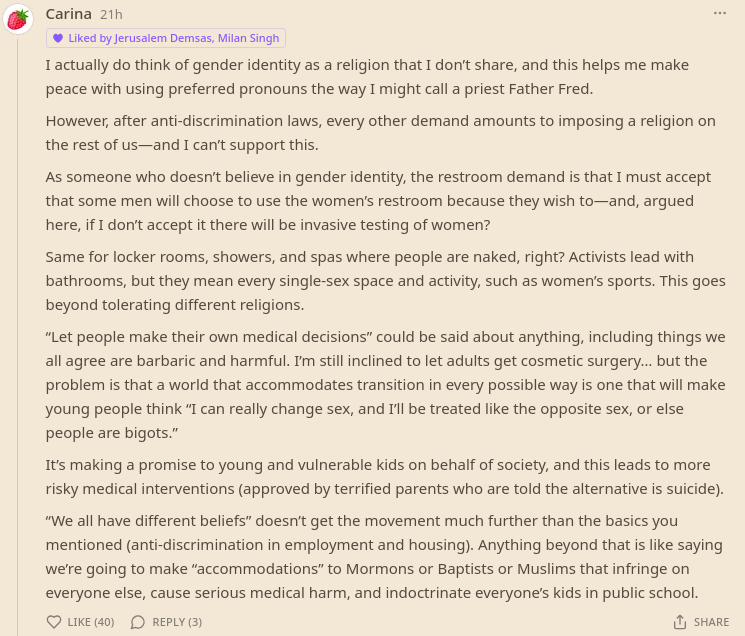
Carina takes the framework and immediately extends it past the point Pritchard intended: "after anti-discrimination laws, every other demand amounts to imposing a religion on the rest of us."[6] For Carina, the distinction between belief and treatment does not exist. If she does not have to believe, she does not have to accommodate: full stop. Bathrooms, locker rooms, sports, healthcare: all of it falls under "imposing a religion." She even frames basic transition-related healthcare as making "a promise to young and vulnerable kids on behalf of society" that she never agreed to.[6] The concession strategy does not create a floor of rights. It creates a ceiling.
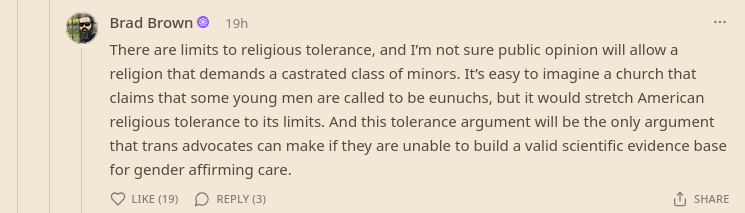
Brad Brown weaponizes the religion analogy in the same direction: "there are limits to religious tolerance, and I'm not sure public opinion will allow a religion that demands a castrated class of minors."[7] He accepts Pritchard's framing, trans identity as belief like a religion, and then uses it to argue that trans healthcare is the moral equivalent of ritual castration. The analogy Pritchard deploys as a bridge becomes, in the opposition's hands, a weapon.
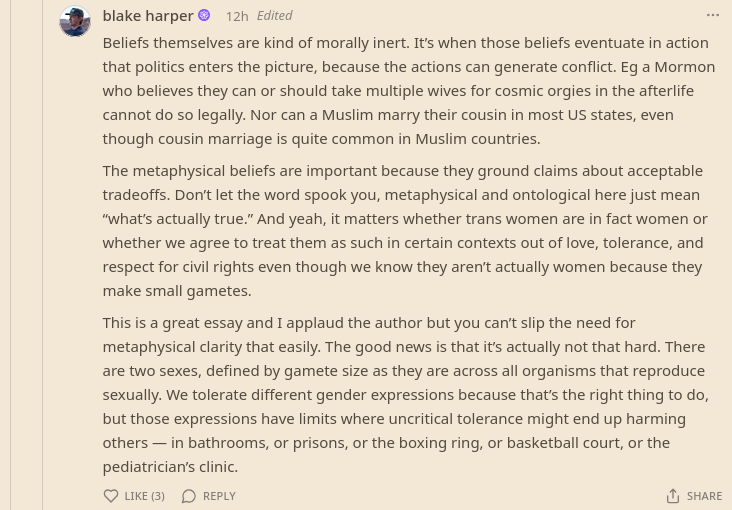
Blake Harper makes the sophisticated version of the same move: "metaphysical and ontological here just mean 'what's actually true.' And yeah, it matters whether trans women are in fact women or whether we agree to treat them as such in certain contexts out of love, tolerance, and respect for civil rights even though we know they aren't actually women because they make small gametes."[8] Blake is explicit: the distinction between belief and treatment is incoherent. What you believe determines what treatment is fair. Pritchard's strategy requires the opposition to accept a separation that Blake, speaking for many, says is logically impossible.
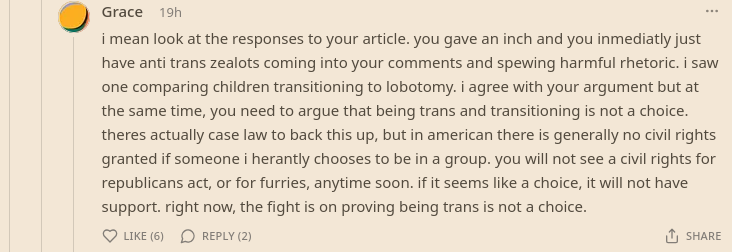

And a pro-trans commenter, Grace, catches the dynamic in real time: "i mean look at the responses to your article. you gave an inch and you immediately just have anti trans zealots coming into your comments and spewing harmful rhetoric."[9] Grace is observing exactly what we are describing: the concession does not satisfy the opposition. It invites them. It signals that the core claim is negotiable, and the opposition rushes in to negotiate it all the way to zero.
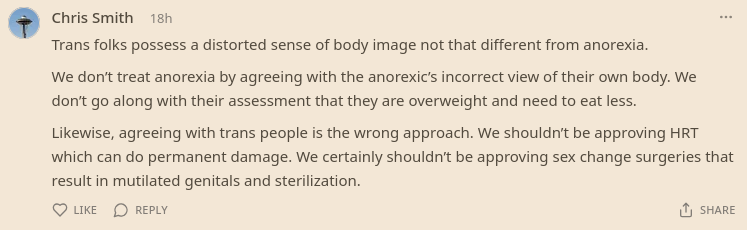
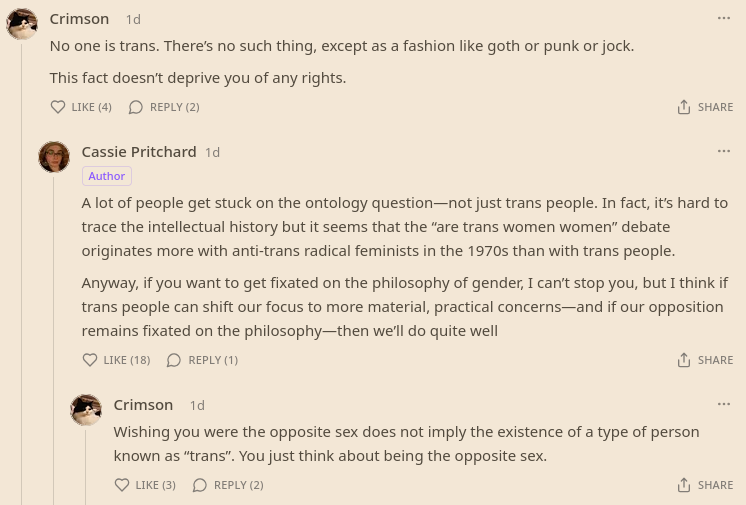
Others compare being trans to anorexia, declare 'no one is trans,' or assert that trans women 'are still male and do not belong in any women's only spaces' — none of which engages with Pritchard's framework at all; it simply rejects the premise. [10–12]
These are not people offering a different ontological belief in good faith. These are people refusing the precondition of mutual recognition. They have removed themselves from the realm of good-faith engagement. Her strategy assumes the persuadable middle will honor the distinction. But the comments section shows what the opposition does with that same logic: they extend it. If the firewall cannot survive a comments section, it will not survive a legislative fight with motivated opponents
The comments section of her own essay disproves her thesis. The strategy does not hold. The opposition does not split the difference. They collapse it, in real time, in public, in response to the very article proposing the strategy.
None of this is to say Cassie Pritchard is arguing in bad faith. She is sincerely trying to solve a real problem. But sincerity doesn't inoculate an argument from the rhetorical moves it employs. When you ask marginalized people to absorb the burden of adaptation while holding the opposition to no corresponding obligation, you're no longer making a strategic proposal - you're reproducing the power dynamic you claim to challenge.
The Atlanta Compromise Parallel
Booker T. Washington's 1895 speech accepted that white Southerners would not see Black people as social equals and asked for economic opportunity and vocational training instead. W.E.B. Du Bois responded with a devastating diagnosis: the framework conceded the premise that powered the opposition's entire position. If you accept that your equality is negotiable, every subsequent negotiation starts from a lower floor.
The parallel is structural, not superficial. Pritchard's "tolerate the disbelief, secure the rights" is the same architecture. And it fails for the same reason: the opposition treats the conceded premise as permission, not as a boundary.
The recycled arguments make this explicit. The skeleton of exclusion does not change, only the target does:
| Common Argument Used | Used Against Black Athletes (1930s-1960s) | Used Against Women (pre-Title IX) | Used Against Trans Athletes (Currently) |
|---|---|---|---|
| Biological advantage | Black athletes have "innate physical superiority" making competition unfair for white athletes[13] | Women's bodies are fundamentally different; mixed competition would be "unfair" | Trans women retain "male biological advantage" making competition unfair for cis women |
| Protect the category | Integration would destroy the integrity of white leagues | Women's sports need protection from being dominated by men's resources | Women's sports need protection from incursion by trans athletes |
| Safety concerns | Black men pose a physical danger to white competitors | Women are physically fragile; contact sports risk injury | Trans women pose physical danger to cis women in contact sports |
| Separate but equal | Black leagues exist; use those | Women have their own events; stay in those | Trans people can create their own category; use that |
| Natural order | Races are naturally distinct categories | Sex is a natural dividing line in sport | Biological sex is immutable; gender identity is irrelevant to sport |
The same playbook, recycled across time. The strategy of conceding ground to appease the playbook did not work then and it will not work now.
The bathroom arguments follow the same pattern. During racial segregation, white women protested bathroom integration, claiming it "stole bathroom facilities from white girls" and exposed them to danger.[14] Gillian Frank documented that the "protect white women in the bathroom" rhetoric used to defend Jim Crow segregation is the direct ancestor of today's anti-trans bathroom bills.[15] Same script, different cast. I have documented these parallels in other work, showing how the words change but the mechanisms remain the same.
There is a deeper problem with adopting the opposition's framing. The arguments in the table above share a common skeleton because they were built by the same logic: that biological categories are immutable, that the dominant group needs protection from the subordinate group, and that separation preserves fairness and safety. When Pritchard proposes that we accept "you don't have to believe we are what we say we are" as the basis for our advocacy, she is accepting the opposition's foundational premise: that our identity is a matter of belief rather than recognition, of opinion rather than fact.
You cannot build an inclusive framework using the exclusionary logic that was designed to exclude. The tools of erasure do not produce presence. Accepting that trans identity is a "belief" that can be tolerated rather than a reality that must be recognized means building our house on the opposition's foundation, and they control that foundation and the land it sits upon.
"Respect Me!" Without Context
Pritchard diagnoses "respect me!" politics sharply: demanding affirmation while being hostile, wanting approval while refusing to cultivate it. She identifies something real in certain discourse patterns. But context matters profoundly.
That said, they do not obligate us to accept dehumanizing rhetoric or engage with those who open with it. That principle operates differently in interpersonal interactions than it does in broader advocacy. When in a broader effort/context, it behooves us to be more patient in the face of opposition for a plethora of reasons, up to a point. I think we can agree on this, even if I disagree on the tone policing framed around it.
There is a material difference between "someone used the wrong pronoun and got corrected" and "someone opened with 'you are a delusional pervert' and got pushed back against." The first might warrant patience. The second is someone who removed themselves from what would otherwise have been a good-faith engagement before the conversation started.
Her framework treats all cis pushback as if it exists on the same plane: a bunch of thin-skinned activists yelling at well-meaning people who just have honest questions. This assumption collapses under scrutiny. When someone opens with dehumanization, they are not offering a belief to be accommodated. They have already refused the precondition of mutual recognition.
Consider the paradox of tolerance: tolerance means coexisting with people who hold different beliefs within a framework of mutual recognition of each other's humanity. Refusing to respect a trans person's name and pronouns is not a belief to be accommodated: it is a refusal of the starting line. When the Overton window shifts so far that basic dignity is not on the table, "respect me!" is not pathology. It is a survival response to dehumanization.
A Black person in 1955 refusing to patiently educate someone who had just called them a racial slur is not evidence of a "respect me!" pathology. It is evidence that the other party removed themselves from the realm of good-faith engagement. Pritchard's framework does not account for where that line is.
Optics vs. Respectability: Drawing the Line
Before closing, a necessary clarification. Strategic messaging, choosing which arguments to foreground in which contexts, adapting language for different audiences, code-switching: this is not respectability politics. Every movement does this. The civil rights movement chose targets deliberately. The NAACP sequenced litigation strategically. King faced criticism from younger activists for being too moderate, but his strategic choices did not involve abandoning the claim that Black people were equal.
The distinction matters. Optics as strategy says: "use this frame in this context because it is more persuasive, while maintaining the core claim elsewhere." Respectability politics says: "sideline the core claim itself because it makes the majority uncomfortable." The first is tactical intelligence. The second is capitulation wearing tactical language.
Pritchard's move is the second. She does not say "use civil rights framing in 'mass politics' while continuing to insist on identity in other spaces." She says the identity claim should be sidelined from "mass politics" entirely. That is not simply optics. That is surrendering ground for, at best, short-term appeasement.
There is a further consequence to this move worth naming. When you accept trans people as rights holders while denying the ontological claim that underpins those rights, you are not offering allyship: you are offering tokenism. "We will protect you, but not as what you are" is not protection. Conditional recognition that says "you can have rights but not identity" reduces trans people to a tolerated abstraction rather than recognized human beings. It is, at its kindest, a leash.
The acceptance was never for you. It was for the performance of tolerance, for the distance it allowed the majority to maintain. The moment the political winds shift, that tolerance has no foundation to stand on because you never insisted that the recognition was real.
Rights without ontological recognition are contingent rather than inalienable. Contingent rights can be negotiated away. The opposition holds the bargaining chip, they control the framework, and they can gradually reduce the chain length without declaring war on trans existence. Just... tightening. Incrementally. Logically. Pragmatically. "Reasonably."
It is what we are seeing happen now, in real time. Our trans rights have never been secured by comprehensive federal legislation, and what judicial and state-level protections exist remain vulnerable, as they rest on judicial interpretation and executive policies - both of which can be reversed by any administration.
In my previous work, I have written about how marginalized communities become enforcers of their own oppression when they mistake familiar cruelty for wisdom, transform trauma into strategy, convince themselves that if they police each other hard enough, maybe the oppressors will stop policing them. "We need to be more strategic" translates to "some of us are expendable." "It is about optics" is respectability politics wearing marketing terminology.[16]
Pritchard's proposal is that pattern's latest iteration. She is not defending the gates consciously. Structurally, she is asking trans people to file themselves down, to file away the claim that defines us from the political arena until we are smooth enough, small enough, acceptable enough to pass through.[17] The bargain has not changed. Only the packaging.
She can attempt to preempt accusations of respectability politics by establishing her bona fides, but that maneuver addresses how the proposal looks, not what it does. The concession operates the same way regardless of who proposes it.
The Two-Domain Framework
There is a clean distinction to draw: Personal belief is free; legal recognition is binding. We do not compel belief, but we do not compromise on recognition.
Interpersonal level: John Doe does not have to believe I am a woman. He just has to treat me with dignity, use my name and pronouns, not discriminate against me. I cannot police his thoughts nor compel his beliefs, and I should not try.
Advocacy/legal level: The law must recognize trans people as who we say we are. Not "we will protect you even though you are not really women," but "you are women, you are men, you are nonbinary people, and the law recognizes this." The legal framework is premised on ontological recognition, just as civil rights law recognizes Black Americans as citizens without adjudicating racial authenticity. The law doesn't ask "do you believe this person is really Black?" It recognizes racial identity as legitimate and indelible aspect of one's humanity and personhood, and grants equal protection. The law should recognize trans identity for the same reason: it is real, documented, and the people who hold it deserve equal standing.
Pritchard's error is crossing the domain boundary: taking interpersonal tolerance and applying it to general advocacy, where it becomes concession. She wants the legislative win without the cultural work, but the cultural work is what makes the legal win durable and sustainable. This gets at something crucial: visibility is not a luxury of rights movements, it is the mechanism by which rights become durable.
As Dr. Saunders warns from her vantage point in the UK, where this erosion is not hypothetical but lived reality: "the moment you accept that one element in society is worth casting aside in the fight for rights, the moment the fight for rights is lost because they will come for us all in the end."[5] We arrive at the same conclusion through our own history: the Atlanta Compromise failed because it accepted the principle of expendability. Pritchard's proposal accepts the same principle. The principle does not care about your intentions. It operates structurally, mechanically, and without mercy.
Cassie Pritchard is genuinely trying to solve a real problem; unfortunately, in attempting to solve one problem, her proposal replicates a deeper and more problematic historical pattern. History tells us, with depressing consistency, where that leads.
All of us, or none of us.
That is not naive idealism. That is the lesson history teaches those willing to learn.
CITATIONS
[1] Pritchard, C. (2026, August 11). I don't need you to believe I'm a woman. The Argument. https://www.theargumentmag.com/p/i-dont-need-you-to-believe-im-a-woman
[2] Allport, G. W. (1954). The nature of prejudice. Addison-Wesley. https://archive.org/details/natureofprejudic00allprich/page/n5/mode/2up
[2b] Pettigrew TF, Tropp LR. A meta-analytic test of intergroup contact theory. J Pers Soc Psychol. 2006 May;90(5):751-83. doi: 10.1037/0022-3514.90.5.751. PMID: 16737372. https://pubmed.ncbi.nlm.nih.gov/16737372/
[3] Brennan Center for Justice. (2023, June 23). Effects of Shelby County v. Holder on the Voting Rights Act. https://www.brennancenter.org/our-work/research-reports/effects-shelby-county-v-holder
[4] ILGA-Europe. (2025). UK joins Hungary and Georgia with the biggest drops on annual LGBTI rights ranking [Press release]. https://www.ilga-europe.org/press-release/press-release-uk-joins-hungary-and-georgia-with-the-biggest-drops-on-annual-lgbti-rights-ranking/
[5] Saunders, R. (2026, August). Rights are a narrative process. Medium. https://rejserin.medium.com/rights-are-a-narrative-process-18ee1e67b0c9
[6] Carina. (2026, August 11). Comment on "I don't need you to believe I'm a woman." The Argument. https://www.theargumentmag.com/p/i-dont-need-you-to-believe-im-a-woman
[7]–[12] refer to the same article and url/comments section as [6] above.
[13] Kerr, I. B. (2010). The myth of racial superiority in sports. ScholarWorks at Western Michigan University. https://scholarworks.wmich.edu/cgi/viewcontent.cgi?article=1027&context=hilltopreview
[14] National Archives Foundation. (n.d.). Batting away Jim Crow. Retrieved from https://archivesfoundation.org/newsletter/batting-away-jim-crow/
[15] Frank, G. (2015, November 9). The anti-trans bathroom nightmare has its roots in racial segregation. Slate. https://slate.com/human-interest/2015/11/anti-trans-bathroom-propaganda-has-roots-in-racial-segregation.html
[16, 17] Valah. (2024). When we police ourselves. People with Inconvenient Truths About Transphobes. https://valah.blog/when-we-police-ourselves