When We Choose Each Other

A Manifesto for Liberation Now
The Fact of Our Binding
James Baldwin wrote: "Not everything that is faced can be changed, but nothing can be changed until it is faced." But there is something else Baldwin understood, something that sits beneath every essay he wrote, every warning he issued, every plea he made. It is this: our liberation is not separate. Our fates are bound together in ways we cannot escape, no matter how hard we try. "If the concept of the Negro in this country operated as a figure in American destiny," Baldwin said, "it operated as a figure in the destiny of the world." Replace Negro with trans, with disabled, with poor, with incarcerated, with immigrant, with lesbian, gay, bisexual, or non-binary, and the truth remains. We are tethered to one another. Not romantically. Not as abstraction. But materially, morally, strategically. The freedom of the most oppressed among us is the condition for the freedom of all of us. We cannot be free while we leave anyone behind.
This is not sentimental. This is not idealism.
It is the foundational truth of liberation.
When We Mistake Administration for Power
The fear and claim is that trans rights have collapsed in the United States. Not quietly, but catastrophically. In 2022, support for protecting trans people from discrimination in jobs, housing, and public spaces stood at certain levels. By 2025, it had dropped eight points. Health insurance coverage for gender-affirming care lost five points. What was once framed as inevitable progress—"the arc of history bending toward justice"—now bends visibly backward.
This did not happen because the arguments were weak. The medical evidence for gender-affirming care is robust. The legal case against discrimination is sound. Courts have affirmed that gender identity discrimination violates civil rights law. The moral argument is unassailable: trans people deserve to exist, to be recognized, to access healthcare, to participate in public life.
And yet.
Over the past two decades, trans rights were advanced primarily through administration, not legislation. Through executive orders. Court rulings. Agency guidance. The Obama administration issued Title IX guidance protecting trans students. The Biden administration reversed Trump's military ban through executive order, proposed Title IX protections, and restored health protections. These were good policies. They were based on evidence. They protected real people.
But they were implemented without the public persuasion, without the legislative battles, without the mass mobilization that builds durable power. We ruled without consent. We imposed change from above. And when power shifted, everything came undone. This was always the risk when our rights were not codified into law; that which can be given by the stroke of the pen, can be taken away by another.
How Movements Actually Build Power
But there is another way. History shows us.
The Student Nonviolent Coordinating Committee (SNCC) did not wait for permission to register Black voters in the South. They did not defer to polling or public opinion. They organized from the ground up. Young people, mostly Black, rooted in communities, building power through distributed leadership, cultural resistance, and integrated political analysis. They connected racism to colonialism, to economic exploitation, to the entire architecture of oppression. They sustained themselves through culture—through song, through shared analysis, through choosing each other over and over in the face of violence and loss. And they changed the country.
ACT UP, during the AIDS crisis, did not ask the FDA for permission. They did not wait for approval from mainstream opinion, which largely despised them. They organized through autonomous affinity groups and general assemblies. They kept trans people of color and the most affected at the strategic center. They refused hierarchy. They moved at lightning speed. And they forced a government and a medical system to move faster than either wanted to. They saved lives, they built a foundation upon which, later, changed the country.
But here is what we must reckon with: the trans movements of the past two decades were often led by those furthest from state violence. White trans people, cis people, people with resources. We advanced through administration and elite persuasion while trans women of color—Black trans women especially—were dying in the streets. We built hierarchies of respectability where some trans people were deemed "acceptable" and others were expendable. We did not defend our most vulnerable. We did not center their leadership. We did not bleed standing for them. And that failure is written into every loss we are experiencing now. Because you cannot build durable power on the sacrifice of the most oppressed. That power will collapse the moment it is tested, and it is, and it has.
Both movements did something crucial that we failed to do. They practiced liberation within themselves while fighting for it externally. How they organized was how they were becoming free. The refusal of hierarchy was not a tactic. It was the practice of the world they were building. The centering of the most affected was not strategy. It was the lived expression of their understanding that their liberation was bound together.
And crucially: both movements built power that was rooted. Organizers lived in the communities they organized. These roots created accountability. You could not betray people you lived alongside. You could not burn out those you had to face every day. You could not sacrifice the vulnerable when the vulnerable were your neighbors, your lovers, your siblings.
Neither movement waited for the majority to agree. Neither movement deferred to popular opinion. Both movements created the conditions for public opinion to shift, not by being "palatable," but by being undeniably powerful, by making change impossible to ignore, by centering the humanity of those most erased.
This is a call for refusal to repeat that failure. It is a call for commitment to rooted accountability, to centering trans people of color, to those most harmed and vulnerable, to understanding that our liberation is literally impossible without the liberation of those bearing the most weight.
Freedom Is a Practice, Not a Destination
Simone de Beauvoir wrote: "One is not born free, one becomes free." This is the philosophical heart of everything. Freedom is not a state you achieve after winning power. It is not something you earn by performing acceptability. It is a practice. Something you do. Something you become through the act of choosing.
This changes everything.
It means that movements claiming to fight for liberation must practice liberation now. How you organize is the world you are building. If you are fighting for a world without hierarchy, you cannot organize hierarchically and expect liberation to emerge once you have won. If you are fighting for a world where the most vulnerable are protected, you cannot sacrifice vulnerable people now in hopes of protecting them later. The means do not lead to the ends. The means are the ends, lived in advance.
Angela Davis, in her writings on abolition and resistance, understood this. "Resistance is not just an individual thing; it is also collective." But more. Resistance must include the refusal to replicate the oppressor's structures within our own movements. "We must imagine ourselves and others differently," Davis wrote. Not as hierarchical leaders and followers, not as professionals and beneficiaries, not as those who decide for others, but as people choosing each other, repeatedly, across difference and disagreement.
Audre Lorde spoke of the erotic, not as sexuality, but as power. As the capacity to feel deeply, to connect authentically, to refuse the deadening efficiency of systems built on domination. "In order to perpetuate itself," Lorde wrote, "every oppressive system must corrupt or distort those various sources of power within the culture of the oppressed that provide energy, information, connection." Trans movements built on elite persuasion and administrative victories; movements that replace deep connection with social pressure, that substitute efficiency for care - these movements corrupt their own power. They become what they fight against.
The movements that last, the movements that actually transform, are the ones that practice the world they are fighting for. That center care alongside militancy. That build, invest, and move at the speed of trust. That refuse to sacrifice the vulnerable. That understand that how they treat each other is how they are becoming free.
This is not weakness. This is the only strength that lasts.
Choosing Each Other as a Revolutionary Act
When we practice liberation now, we build something unprecedented. We do not wait for permission. We do not defer to polls. We do not ask those who are profiting from our oppression to validate our existence. We do not negotiate for our rights or attempt to purchase respect at the cost of each other. We do something radical instead.
We choose each other.
We choose each other when we build resource commons. Shared housing, collective care, mutual aid networks that allow survival outside systems designed to extract and control. We choose each other when we organize through distributed power, through rotating coordinators and affinity groups, ensuring that no single person consolidates authority. We choose each other when we keep the most marginalized at the strategic center. Not as tokens, but as the source of our clearest vision, the voice of our collective conscious.
We choose each other when we build culture as infrastructure. Art, music, storytelling, shared analysis that coordinates our movement without command. We choose each other when we stay rooted, when we live alongside those we organize, when we make ourselves accountable not to funders or institutions but to our communities. We choose each other when we refuse to fragment our analysis, when we connect transphobia to racism, to colonialism, to poverty, to state violence, to the entire machinery of domination.
We choose each other when we refuse conditional rights. When we say: not some of us deserve dignity. All of us do. Not those who "pass" and are "respectable" and make others comfortable. All of us. When we understand that the moment we allow exceptions, we endanger everyone. When we understand that rights secured through the sacrifice of the vulnerable are not rights at all. They are permissions, revocable and conditional. We choose each other when we realize we do not owe others their comfort.
This is not a strategy designed to win polls. It is the practice of becoming ungovernable, unco-opted, unstoppable.
The Choice Before Us
We are at a moment of rupture. The administrative victories are collapsing. The illusion of power has shattered. We have been forced to face a truth we tried to avoid. We built on sand.
But this crisis is also clarification. It reveals what was always true: that the only durable power is power rooted in people. That the only liberation that lasts is liberation practiced now, within our movements, by people choosing each other unconditionally.
We can respond in two ways.
We can double down on respectability. We can fragment further, deciding that some trans people are "acceptable" and others are not. We can apologize for our existence. We can perform humility before those who will never accept us. We can try once more to purchase respectability from those who are ideologically committed to our erasure. We can do all this, and we will fail. History shows us we will fail. We cannot purchase respectability from those who will never accept us or respect us. We cannot buy what is not for sale.
Or we can choose each other.
We can build movements rooted in the understanding that our liberation is mutual, interdependent, bound together. We can practice freedom now. Through how we organize, how we make decisions, how we care for each other, how we refuse to sacrifice the vulnerable. We can build power that cannot be reversed by a single election, that cannot be co-opted by funders, that cannot be dismantled by courts, because it is embedded in the legal foundations of our respective countries and within the communities that sustain themselves and their governments.
We can understand that this is harder. That distributed power is slower than hierarchy. That moving at the speed of trust takes longer than moving at the speed of efficiency. That this requires sacrifice. Not of the vulnerable, but of convenience, of comfort, of the privilege of not having to show up.
But we can also understand what Baldwin understood. That we are bound to each other, that our fates are woven together, that the freedom of the most oppressed is the condition for the freedom of all of us.
James Baldwin, in his final years, spoke of love not as sentiment but as a political practice. "Love takes off the masks that we fear we cannot live without and know we cannot live within," he wrote. "I use the word love, here, not in a sentimental way, but as a coercive force." Love as the refusal to abandon anyone. Love as the commitment to choose each other unconditionally. Love as the commitment to show up, speak out, and support each other. Love as the practice of liberation now.
This is the movement. Not for winning. But for becoming.
For becoming free, together.
Not just one of us, not just some of us, but for all of us.
For choosing each other, again and again, until the world transforms not because we convinced anyone, but because we made ourselves ungovernable. Until we built power that could not be taken away. Until we showed that another way of moving is possible. Rooted yet distributed, militant yet tenderly committed to the most vulnerable among us. A broad coalition united under the common cause and voice, not "trans rights are human rights" not "trans women are women" or any other pithy slogan. Solidarity is not a bumper sticker or vibes. It is a promise.
A promise that when we choose each other, we become what we are fighting for.
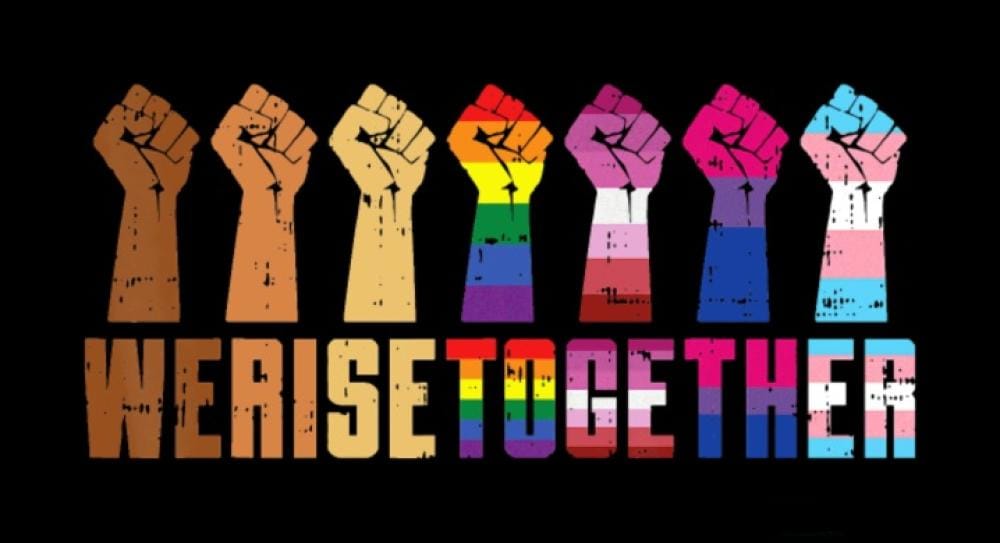
Black, Brown, Woman, Lesbian, Gay, Bi, Trans, Non-binary, disabled, immigrant, young or old. When we choose each other, we stand for each other, we fight for each other, we bleed for each other, and we hold the line and march together.
Step by step.
That is not a promise of victory. It is a promise of practice. It is the only kind of promise that endures.
The Covenant
James Baldwin said it: "I am not free while you are not free."
Dr. King wrote it: "Injustice anywhere is a threat to justice everywhere. We are caught in an inescapable network of mutuality, tied in a single garment of destiny. Whatever affects one directly, affects all indirectly."
That is not sentiment. It is a material reality. It is the foundation of everything we are building, everything we needs must stand for.
The question before us is simple: Will we practice it? Will we build it? Will we choose each other, over and over, knowing the cost, choosing it anyway?
The door stays open. The walls still hold.
Because we are in the midst of learning that, as Dr. King so eloquently stated then, his wisdom still rings true today: "We know through painful experience that freedom is never voluntarily given by the oppressor; it must be demanded by the oppressed....For years now I have heard the word "Wait!" It rings in the ear of every Negro with piercing familiarity. This "Wait" has almost always meant 'Never.'"
Come.
This is our call. This is our architecture.
Our liberation is collective, or it is nothing.
This is our time to build.