The Quiet We Endure


The Quiet We Refuse
There is a trap built into the floorboards of being trans. You feel it every time you smile at a stranger who stares too long, every time you soften your voice to keep the peace, every time you say "it's fine" when it is not fine.
The trap works like this: they grind you down. The gatekeepers who demand you prove your pain and keeps doubting your experience - "are you sure you still want to proceed with this?". The parent or sibling who still uses the wrong name after five years. The "just asking questions" crowd who have never asked a question in good faith. The rude comments, insults, harassment, and bullying. "Freak," "Tranny," "mentally ill" and misgendering, the physical, emotional, and verbal abuse levied against you day in an day out, from the the subtle to the overt. They grind you down until something in you snaps. Maybe you raise your voice in the pharmacy. Maybe you cry in the parking lot. Maybe you yell back "Fuck you, asshole!" Maybe you just stop pretending to be grateful for table scraps. Maybe you dare to have some self-respect and stand up for yourself. To be a whole person in their presence.
And the moment you break the facade of calm indifference to their provocation, they point. They say: See? This is why we can't give you rights. You're too emotional. Too angry. Too mentally unstable. Too hormonal. Just too much.
This is the double-bind. To know exactly what is being done to you, to see the architecture of the cage, is to be in a state of fear, hurt, and anger almost all of the time. Not because we are fragile, but because they are cruel, and that cruelty is the point. Breaking us is the goal.
We have been taught, oh how we have been taught, to carry the weight quietly.
The quiet looks like survival. It looks like the trans woman who accepts the misgendering because she doesn't want to be difficult. The non-binary person who lets "she/them is enough" slide even as their skin crawls. The disabled trans person who doesn't ask for the chair, the extra time, or the accommodation they need because they've already been told they are too complicated, too much paperwork, too many needs for a body that already requires so much just to stay alive in a world that wishes it wouldn't.
We call this strategy. We call it optics. We call it protecting the movement.
But when we swallow our rage to make others comfortable, we are not being strategic. We are being digested. We are learning to collaborate in our own erasure until the judge and the judged share the same body, and we call it assimilating, passing, "blending in" and "not making waves." We file ourselves down, our voices, our histories, our hurt, fear, and anger until we are smooth enough to slip through gates that were never meant to open for us. And then, having survived by becoming smaller, we are positioned to make others small. We become the gatekeepers. We tell the youth: don't be too loud. Don't be too visible. Don't ruin this for the rest of us.
We mistake the familiar weight of the chains and the confines of our cage for the comfort and safety of belonging.
But the quiet has a cost. It is measured in the shoulders that never unclench, the jaws that grind at three in the morning, the years we spend editing ourselves in real time, watching our own words, monitoring our own history, until our own stories become unrecognizable to us. The quiet costs us our disabled siblings, for whom the double-bind is a thriced up: prove your pain is real, but don't show it; prove your gender is real, but don't make it visible; prove you deserve to exist, but never take up too much space doing it. It costs us our Black trans siblings, who face the intersection of every oppression and are told their anger is threatening when it is simply human. It costs us our youth, who are told to wait, to be patient, to let the adults negotiate away their futures for respectability that keeps receding like a mirage. It costs us our voice and visibility, as we retreat to our homes and safe spaces.
We measure these costs in lives lost.
This trap is not unique to trans folks, though trans bodies are where it often tightens most visibly. We are the emissaries at the intersection: the disabled trans person navigating the triple-bind, the Black trans woman facing the convergence of every aggression, the autistic trans person whose directness is read as threat. The mechanism is universal; the cage is specific. Those who survive its narrowest corners know the mechanism most intimately.
We have confused our calluses for achievements. We have learned to call the capacity to endure abuse "resilience" and survive oppression as "strength," when it is only survival. We have survived, yes - but survival isn't living.
And then, the breaking. The moment the quiet weight becomes too heavy to carry, the cost too great to bear.
They wait for this. They need it. They provoke it. Your anger, your tears, your refusal to smile back, any action of self-defense and self-respect: these acts become the evidence that you were never worthy of rights in the first place. You were given an inch and you took a mile. You were offered protection and you threw it back in their faces. You were offered assimilation and you chose authenticity.
But let us be clear about what they mean when they call us threatening. They do not mean we are dangerous to their personal safety. They mean we are inconvenient. They mean our existence threatens their comfort, their certainty, their unexamined assumption that the world was built correctly and we are merely glitches in the code. When they say we are threatening, they mean we refuse to perform gratitude for our own marginalization. We refuse to be the tragic figures they can pity from a distance, the convenient scapegoat for their own inadequacies, the canvas for their own projection. We refuse to carry our pain quietly so they never have to feel the weight of what they participate in.
The breaking is not proof that we are volatile or dangerous. It is proof that we are still conscious, that we have eyes that can see, a heart that bleeds, a will that refuses to be confined and constrained for the sake of your comfort. That we have not yet accepted the terms of our imprisonment.
That we refuse to be "reasonable" in the face of the unreasonable.
And that is the way out. Not by choosing differently within the binds offered, but by refusing their very premise. By saying: I am not the problem. The cage is the problem.
The quiet was never protection. It was a leash. And leashes can always be shortened. They can be tightened. They can become a tether, then a trap, then a weight that pulls you under. The quiet is a stay of execution, and stays of execution can always be revoked.
They want us divided, categorizing ourselves into good and bad, reasonable and too much, the ones who file themselves down and the ones who refuse. We are called 'reasonable' when we swallow our pain and bite our tongue, and 'delusional' or 'dangerous' the moment we speak it aloud. The labels shift to fit the cage they need us in. They want us to police each other because it is more efficient than policing us themselves. When external enforcement fails, internal enforcement succeeds. They want us to believe that freedom can be won by narrowing its definition until only the already-free fit inside.
But we know better. We know that conditional acceptance is not acceptance. It is a receipt for a debt that will never be paid. We know that partial freedom is not freedom. We know that when we ask each other to be smaller, quieter, less threatening, we are not protecting the movement - we believe we are protecting ourselves in the name of the movement, when we are really protecting them and the status quo. In reality, we are fracturing the movement. We are turning the vulnerable into acceptable casualties. We are trading futures for the temporary comfort of those who have already made it through.
And the quiet is killing us.
We are done filing ourselves down. We are done policing our siblings to buy our own conditional safety. We are done carrying the weight quietly until it kills us.
The breaking is not the end. It is the beginning. It is the sound of the cage cracking. It is the gravity we exert, pulling everything toward truth.
Because here is what they cannot bear: we do not need their acceptance to be authentic. We do not need their approval to be real. We do not need to file ourselves down to deserve to exist.
We just need to stop accepting the terms.
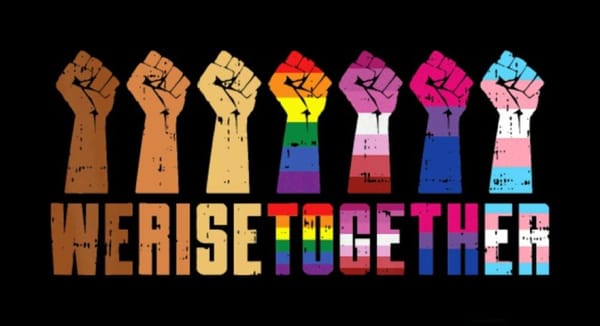
All of us, or none of us. And that all includes every body that has been told it takes up too much space, every voice deemed too loud, every flash of anger that dares to say: I am here, and I will not apologize for the space I occupy, that I am not sorry I exist, that I deserve the same dignity and respect you do.
The price was never meant to be us. The quiet was never meant to be the condition of our survival.
The time for quiet is over.